DIS2026 logo

DIS2026 at Bologna: the international conference on deep inelastic scattering

The international conference DIS2026 kicks off today, May 4, in Bologna at the Royal Carlton Hotel Conference Center. This is the 33rd edition of the International Workshop on Deep Inelastic Scattering and Related Subjects. The event will bring together 350 physicists from around the world.

The central theme of the conference, which will conclude on Friday, May 8, is the study of high-energy collisions between electrons and nucleons (protons and neutrons), known as “deep inelastic scattering.” This field of research has played a fundamental role in the development of particle physics. It was precisely through experiments in this area that the existence of quarks—the elementary particles that make up protons and neutrons—was confirmed.

The conference, jointly organized by the Bologna and Ferrara Divisions of INFN and the Universities of Bologna and Ferrara, will offer participants the opportunity to explore and discuss many of the still open questions in this field of research. The INFN Bologna Division has a long-standing tradition of both theoretical and experimental work in this area, notably through the ZEUS experiment at the HERA collider in the 1990s and early 2000s, continuing today with involvement in the SND experiment at CERN in Geneva and the ePIC experiment at the future Electron-Ion Collider in the United States.

The DIS conference returns to Bologna for the second time. Twenty-five years ago, the city hosted DIS2001, chaired by Antonino Zichichi, then a full professor at the University of Bologna and former president of INFN. This year’s edition will therefore include a contribution in memory of the distinguished scientist, who recently passed away.

On Saturday, May 9, from 2:00 PM to 6:00 PM, a public outreach satellite event will also take place, particularly aimed at children aged 5 to 11, at the San Giovanni in Monte Complex and Cloister. Young participants will be able to explore the properties of light by taking part in the interactive workshop-performance “Where do colors come from?”.
 

IFAE2026 logo

Bologna hosts IFAE 2026, Italy’s leading conference on high-energy physics

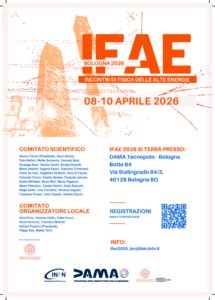
The Incontri di Fisica delle Alte Energie (IFAE) 2026 will take place in Bologna from April 8 to 10, 2026, at DAMA – Tecnopolo. The event, organized by INFN and the Department of Physics and Astronomy “Augusto Righi” of the University of Bologna, represents the main national conference dedicated to high-energy physics.

The conference, primarily aimed at PhD students and early-career researchers, will provide an important opportunity to present the most recent results of their scientific activities and to engage with the Italian community in the field. The scientific program is structured around four research areas: Energy Frontier, Intensity Frontier, Astroparticles and Cosmology, and New Technologies, reflecting the richness and multidisciplinarity of research in this domain. More than 150 participants from across Italy are expected.

As part of the conference, a visit to the INFN national computing center (CNAF) is also planned. This center represents a key node in the global computing infrastructure for high-energy physics, playing a crucial role in the processing, distribution, and analysis of data produced by all experiments involving INFN, including those at CERN, the European Organization for Nuclear Research. The Italian Tier-1 facility plays a central role at both national and international levels, supporting thousands of researchers and providing high-level computational resources to the scientific community.

The full conference program is available online: https://agenda.infn.it/event/47878/

At the conclusion of the conference, prizes will be awarded for the best oral and poster presentations, highlighting the contributions of young researchers and the excellence of the work presented.

Masterclass2026 logo

INTERNATIONAL MASTERCLASSES “HANDS ON PARTICLE PHYSICS” 2026 Bologna, March 23–27, 2026

In Bologna, nearly 150 high school students will become physicists for a day

Bologna, March 2026 — From March 23 to 27, 2026, Bologna will host five days of immersion in particle physics as part of the International Masterclasses “Hands on Particle Physics”, an international initiative coordinated by the IPPOG (International Particle Physics Outreach Group), which annually involves over 13,000 high school students in 60 countries around the world.

The Bologna edition is organized by the INFN Bologna Section in collaboration with the Department of Physics and Astronomy of the Alma Mater Studiorum – University of Bologna, at the Academy of Sciences of the Bologna Institute.

The day-by-day program 

Monday, March 23 – KM3NeT. For the first time in Bologna, the Masterclasses open up to the world of particle astrophysics thanks to the KM3NeT experiment, a giant underwater telescope installed in the depths of the Mediterranean Sea. Students will analyze real events recorded by the detector to identify signals produced by cosmic neutrinos: nearly invisible particles, devoid of electrical charge, capable of passing undisturbed through the entire Universe and the Earth. This very elusiveness makes them valuable messengers of extreme astrophysical phenomena—supernova explosions, gamma-ray bursts, active galactic nuclei—that light alone cannot detect.

Tuesday, March 24 – ALICE. Students will examine real events collected by the ALICE experiment to search for strange particles—containing strange quarks—produced in the LHC’s ultrahigh-energy collisions. The search is based on the recognition of two different types of decay, called “V0” and “cascade.” Abundant production of strange quarks could be the signature of a quark-gluon plasma, the primordial state of matter that existed in the very first moments after the Big Bang.

Thursday, March 26 – ATLAS. Students will analyze data from the ATLAS experiment to rediscover the Z boson and other known particles, search for the Higgs boson, and explore possible evidence for as-yet-unknown particles that could point to physics beyond the Standard Model.

Friday, March 27 – Particle Therapy. Physics that saves lives. Students will examine real-world events to understand the techniques behind particle therapy for cancer, which uses X-rays, proton beams, or carbon ions as precision “scalpels” guided by sophisticated software. This is a concrete and powerful example of how fundamental research in particle physics translates into direct benefits for people’s health.

Each day is divided into morning seminars led by active researchers, followed by afternoon computer-based data analysis sessions using the same software tools used by professional physicists. Afterward, international video conferences allow students from Bologna to discuss their findings with their peers from around the world—just as happens in large international scientific collaborations.

.

Francesca Ercolessi wins the INFN “Claudio Villi” award for best PhD thesis in nuclear phsyics 2024

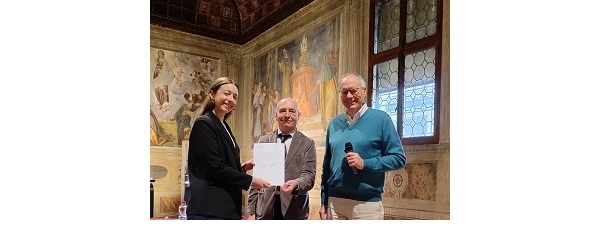
Francesca Ercolessi, a research fellow at the University of Bologna and INFN Bologna, is one of the two winners of the “Claudio Villi” Prize for the best doctoral thesis in nuclear physics.

The award, established by the National Institute for Nuclear Physics, was presented on February 5, 2026, in Padova during the meeting of the National Scientific Commission 3. It recognizes the excellence and
originality of theses defended between June 1, 2023, and May 31, 2024.

Francesca earned this prestigious recognition for her PhD thesis, which was defended at the University of Bologna, titled: “The interplay of multiplicity and effective energy for (multi)strange hadron production in pp collisions at the LHC.” Her work focuses on the production mechanisms of hadrons with high strangeness content generated in proton-proton collisions at the Large Hadron Collider (LHC) at CERN, analysing data collected by the ALICE experiment during Run 2.

The concept of effective energy, introduced by Prof. Antonino Zichichi in the early 1980s, is a key observable for properly accounting, in hadronic interactions, for the energy actually available for particle
production. The study reported in the thesis, published in the Journal of High Energy Physics, demonstrated a strong correlation between effective energy and the increased production of baryons containing the strange quark, providing a clearer explanation for a phenomenon previously observed at the LHC as a function of the multiplicity of the total number of particles produced in each event.

Francesca Ercolessi, 30 years old, holds a Master’s degree in Physics from the University of Bologna, where she specialized in nuclear and subnuclear physics. She completed her PhD at the same institution, during which she was an active member of the ALICE collaboration within the TOF group.

Important award to Romano Serra

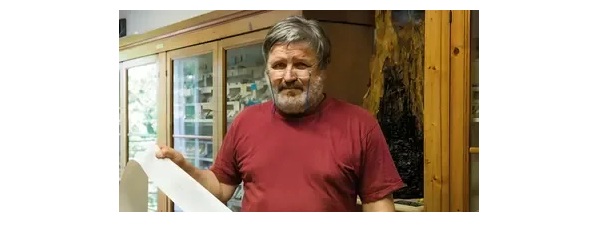
Romano Serra, former university staff member and INFN associate, now retired, has been awarded the Pesco d’Oro, the highest honorary distinction of the City of San Giovanni in Persiceto, in recognition of his outstanding cultural and scientific achievements.
The award honors a lifetime devoted to research and to the dissemination of scientific knowledge which, through his extensive work at the planetarium, helped bring San Giovanni in Persiceto to prominence well beyond national borders.