In Bologna, nearly 150 high school students will become physicists for a day
Bologna, March 2026 — From March 23 to 27, 2026, Bologna will host five days of immersion in particle physics as part of the International Masterclasses “Hands on Particle Physics”, an international initiative coordinated by the IPPOG (International Particle Physics Outreach Group), which annually involves over 13,000 high school students in 60 countries around the world.
The Bologna edition is organized by the INFN Bologna Section in collaboration with the Department of Physics and Astronomy of the Alma Mater Studiorum – University of Bologna, at the Academy of Sciences of the Bologna Institute.
The day-by-day program
Monday, March 23 – KM3NeT. For the first time in Bologna, the Masterclasses open up to the world of particle astrophysics thanks to the KM3NeT experiment, a giant underwater telescope installed in the depths of the Mediterranean Sea. Students will analyze real events recorded by the detector to identify signals produced by cosmic neutrinos: nearly invisible particles, devoid of electrical charge, capable of passing undisturbed through the entire Universe and the Earth. This very elusiveness makes them valuable messengers of extreme astrophysical phenomena—supernova explosions, gamma-ray bursts, active galactic nuclei—that light alone cannot detect.
Tuesday, March 24 – ALICE. Students will examine real events collected by the ALICE experiment to search for strange particles—containing strange quarks—produced in the LHC’s ultrahigh-energy collisions. The search is based on the recognition of two different types of decay, called “V0” and “cascade.” Abundant production of strange quarks could be the signature of a quark-gluon plasma, the primordial state of matter that existed in the very first moments after the Big Bang.
Thursday, March 26 – ATLAS. Students will analyze data from the ATLAS experiment to rediscover the Z boson and other known particles, search for the Higgs boson, and explore possible evidence for as-yet-unknown particles that could point to physics beyond the Standard Model.
Friday, March 27 – Particle Therapy. Physics that saves lives. Students will examine real-world events to understand the techniques behind particle therapy for cancer, which uses X-rays, proton beams, or carbon ions as precision “scalpels” guided by sophisticated software. This is a concrete and powerful example of how fundamental research in particle physics translates into direct benefits for people’s health.
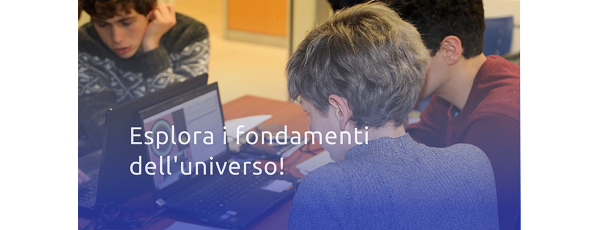
Each day is divided into morning seminars led by active researchers, followed by afternoon computer-based data analysis sessions using the same software tools used by professional physicists. Afterward, international video conferences allow students from Bologna to discuss their findings with their peers from around the world—just as happens in large international scientific collaborations.
.